Electronic pilot logbook: is it really legal and EASA-compliant?
Is an electronic logbook legal for an EASA pilot? What the FCL.050 rule says, paper vs digital, signatures and compliance.
Cameron GERARD
Professional pilot and head of flight operations
Key takeaways
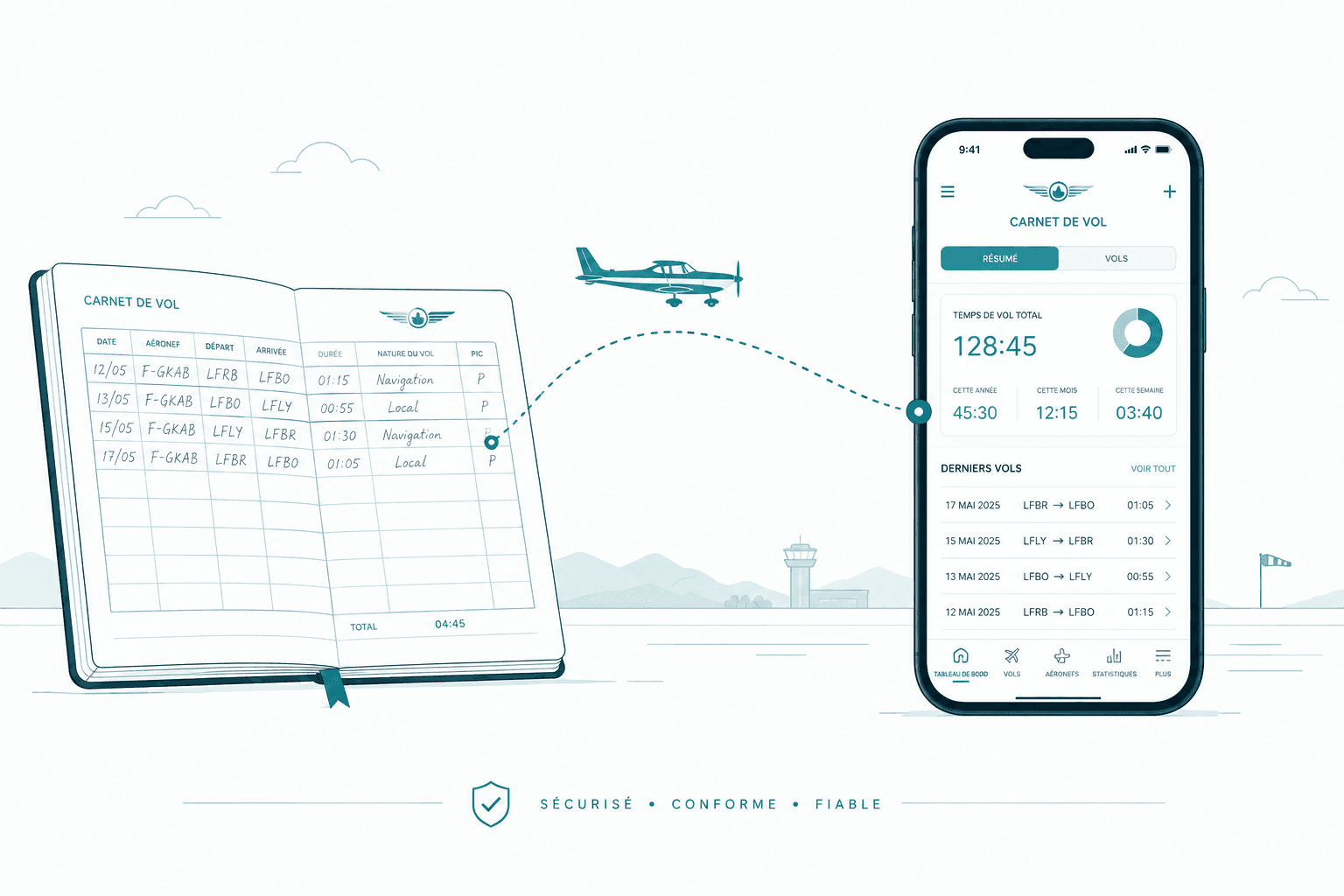
- An electronic pilot logbook is legal and EASA-compliant: FCL.050 requires a reliable record, not a paper format.
- Your obligations do not change: same required fields, same responsibility, logbook available on request.
- The key is export: being able to produce your logbook in the FCL.050 format at any time.
You have kept your logbook on paper since your first lesson, and moving everything to an app leaves a legitimate doubt: is an electronic logbook actually recognised? Will you end up keeping two records just to be safe? The answer is clear, and it lies in the regulation itself. Here is what the EASA rules really say, and what to check to fly with peace of mind.
What the regulation says: content matters, not format
The requirement to keep a logbook comes from point FCL.050 of the Aircrew Regulation (Regulation (EU) No 1178/2011, Part-FCL). Its wording is essential to understand: the pilot shall keep a reliable record of the details of all flights flown, in a form and manner established by the competent authority.
Read it carefully: the regulation dictates what you must record, not the medium you record it on. Nowhere does it say the logbook must be on paper. What matters is that the information is complete, reliable and available.
This is why EASA recognises the electronic logbook. The acceptable means of compliance for FCL.050 set out the expected logbook format, and that format may be kept electronically. In France, the competent authority is the DGAC.
The same means of compliance set the conditions for a valid electronic logbook: it must contain all the required fields, be certified by the pilot, remain readily available at the request of the authority, and be in a format acceptable to it.
Paper or electronic: what changes, what does not
Going digital does not remove any of your obligations. What does not change:
- The required fields stay the same: date, aircraft (make, model and registration), places and times of departure and arrival, name of the PIC, total time of flight, pilot function, and operational conditions (night, IFR).
- You remain responsible for the accuracy of your hours. The logbook, paper or digital, carries your certification as a pilot.
- You must be able to present it to the authority, an examiner or an employer.
What changes, in your favour:
| Paper logbook | Electronic logbook | |
|---|---|---|
| Time calculation (day/night, totals) | Manual, error-prone | Automatic |
| Corrections | Crossings-out | Clean edit |
| Loss or wear | Permanent | Backup possible |
| Finding a flight | Leafing through | Instant |
Digital takes nothing away from compliance: it makes the maths reliable and secures your records, two areas where paper has always shown its limits.
The question of instructor signatures
This is the one point that still calls for some attention. Certain entries in your logbook may require a signature: dual instruction during training, or time flown as PICUS or SPIC, which must be countersigned by the instructor or the PIC. The regulation even explicitly requires the instructor's signature in specific cases: the revalidation of an SEP or TMG class rating, or flights carried out by an LAPL holder to meet recent experience requirements.
Electronic signature solutions exist, but they are not yet universally established in general aviation. In practice, some examiners or clubs still expect a signature made the traditional way.
The advice is simple: choose an application that handles the certification of training time, and keep, where needed, a signed record for the stages of your training that require it. Once you hold your licence, the vast majority of your flights need no signature at all.
Staying compliant and presentable at any time
The real key to peace of mind comes down to one word: export. A compliant electronic logbook must let you, at any moment, produce your logbook in the regulatory FCL.050 format, to present it to an authority, attach it to a job application or hand it to an examiner.
Two principles follow:
- Your data belongs to you. You must be able to export it whenever you want, without depending on anyone.
- For an official procedure (licence application, revalidation, ramp check), keep the ability to print your up-to-date logbook. It is this capability, more than the medium, that keeps you covered.
An application like AerisLog records every field required by FCL.050, automatically computes your day and night times, and lets you export or print your logbook in the regulatory format at any time. Digital then replaces paper day to day, without depriving you of the official document the day it is asked for.
In short
Yes, an electronic pilot logbook is legal and EASA-compliant. The regulation (FCL.050) requires a reliable and complete record of your flights, not a particular medium. Two conditions are enough to fly with peace of mind: a logbook that contains all the required fields, and the ability to present or print it on request.
For your day-to-day flying, you can put the paper logbook away. All you need is a compliant tool that protects your hours and can produce the official format the day it is required.
Ready to make the switch? See how AerisLog keeps your logbook in the FCL.050 format, from entry to export.
Frequently asked questions
Is an electronic logbook legal in Europe? Yes. Point FCL.050 of the Aircrew Regulation requires you to keep a reliable record of all your flights, without mandating paper. A compliant electronic logbook, one that contains the required fields, is certified by the pilot and can be presented on request, is accepted.
Do I need to keep a paper logbook as well? No, not for your day-to-day flying, as long as your electronic logbook is compliant and you can export or print it. For certain official procedures, you simply produce an up-to-date printed version.
Can my instructor sign my hours electronically? Electronic signature solutions exist but are not yet widespread. For training time that must be certified, check that your application supports it, or keep a signed record.
What happens if an authority asks to see my logbook? You must be able to present it. A compliant electronic logbook lets you export or print your complete logbook in the FCL.050 format at any time. AerisLog produces this EASA export, in the same format as a traditional paper logbook, and also offers a QR code that lets the authority view your information in an instant, a feature developed in collaboration with the BGTA (the French Air Transport Gendarmerie).
Regulatory source: point FCL.050, Part-FCL, Regulation (EU) No 1178/2011 (EASA Aircrew Regulation).
Ready to retire the paper logbook?
AerisLog logs your flights in 10 seconds, adds up your totals and keeps an eye on your deadlines. Free, on iOS and Android.