Aeronautical night: definition and how to count night time
When does aeronautical night begin? The official definition (civil twilight), the French 30-minute rule, and how to count your night time.
Cameron GERARD
Professional pilot and head of flight operations
Key takeaways
- Aeronautical night is defined by civil twilight: it begins when the centre of the sun's disc is 6 degrees below the horizon in the evening, and ends when it is again 6 degrees below the horizon in the morning.
- In mainland France, the operational rule is simpler: night begins 30 minutes after sunset and ends 30 minutes before sunrise (15 minutes overseas).
- Aeronautical night (a period) is not the same as night flying (an activity that requires the appropriate rating).
- Your night time counts only from the start of aeronautical night, not from sunset.
"Night starts at sunset plus 30 minutes." You have heard that a hundred times, and it is true... in France. But it is not the official definition, and confusing the two can lead to errors, especially outside mainland France. Here, clearly, is what aeronautical night really is, the practical French rule, and how your night time is counted.
The official definition: civil twilight
The reference definition comes from the European SERA regulation (Implementing Regulation (EU) No 923/2012, Article 2, point (97)). Night is defined there as the period between the end of evening civil twilight and the beginning of morning civil twilight.
And those two moments? Civil twilight ends in the evening when the centre of the sun's disc is 6 degrees below the horizon, and begins in the morning when that centre is again 6 degrees below the horizon.
So it is the sun's angle below the horizon, not a simple addition of minutes, that sets the European definition.
The French 30-minute rule
That astronomical definition is not convenient to apply in flight. This is why the French national supplement to the rules of the air (the "FR" supplement to Article 2, point (97)) allows a practical application:
- for latitudes between 30 and 60 degrees (mainland France): night begins 30 minutes after sunset and ends 30 minutes before sunrise;
- for latitudes at or below 30 degrees (overseas territories): this margin is 15 minutes.
In practice, this is the 30-minute rule you apply day to day in mainland France. It approximates civil twilight without having to compute the sun's position. Other EASA states may apply their own national provisions, so check the rule that applies where you fly.
Aeronautical night and night flying: do not confuse them
Two notions look alike but do not overlap:
- Aeronautical night is a period: the window we have just defined.
- Night flying is an activity: flying during that period, which requires the appropriate rating or privileges, and counts as night time in your logbook.
In other words, aeronautical night tells you when it is night; on its own it does not tell you whether you are allowed to fly at that time.
Counting night time in your logbook
For the logbook, night time is the portion of the flight carried out during aeronautical night. Beware of a common confusion: it is not sunset that switches you into night time. The time flown between sunset and the start of aeronautical night, that is, the 30-minute margin in mainland France, still counts as day time.
In practice, on a flight straddling the start of aeronautical night, only the part after that moment (sunset plus 30 minutes) counts as night time; everything before it stays day time.
This is a tedious calculation by hand: it depends on the date, the location and the time at which aeronautical night begins. AerisLog does it for you: from your aerodromes and times, it automatically works out your day and night times, in the FCL.050 format. See how.
In short
Aeronautical night is officially defined by civil twilight: the centre of the sun 6 degrees below the horizon. In practice, France uses a simpler rule: 30 minutes after sunset and 30 minutes before sunrise in mainland France, 15 minutes overseas. Do not confuse it with night flying, an activity subject to a rating. And for the logbook, leave the night-time calculation to a tool that does it without error.
Frequently asked questions
When does aeronautical night begin in France? In mainland France, 30 minutes after sunset, and it ends 30 minutes before sunrise. Overseas, this margin is 15 minutes. This rule translates the European definition based on civil twilight.
What is the official definition of night? Under SERA (EU 923/2012, Article 2, point (97)), night is the period between the end of evening civil twilight and the beginning of morning civil twilight, those moments being when the centre of the sun's disc is 6 degrees below the horizon.
Are aeronautical night and night flying the same thing? No. Aeronautical night is a period. Night flying is flying during that period, which requires the appropriate rating or privileges.
How is night time counted in the logbook? It is the portion of the flight carried out during aeronautical night. The 30-minute margin after sunset still counts as day time; night time begins only at the start of aeronautical night.
Regulatory sources: definition of "night", Article 2 point (97) of SERA, Implementing Regulation (EU) No 923/2012; the 30-minute rule, French national supplement ("FR") to Article 2 (97), from the Order of 11 December 2014 implementing SERA.
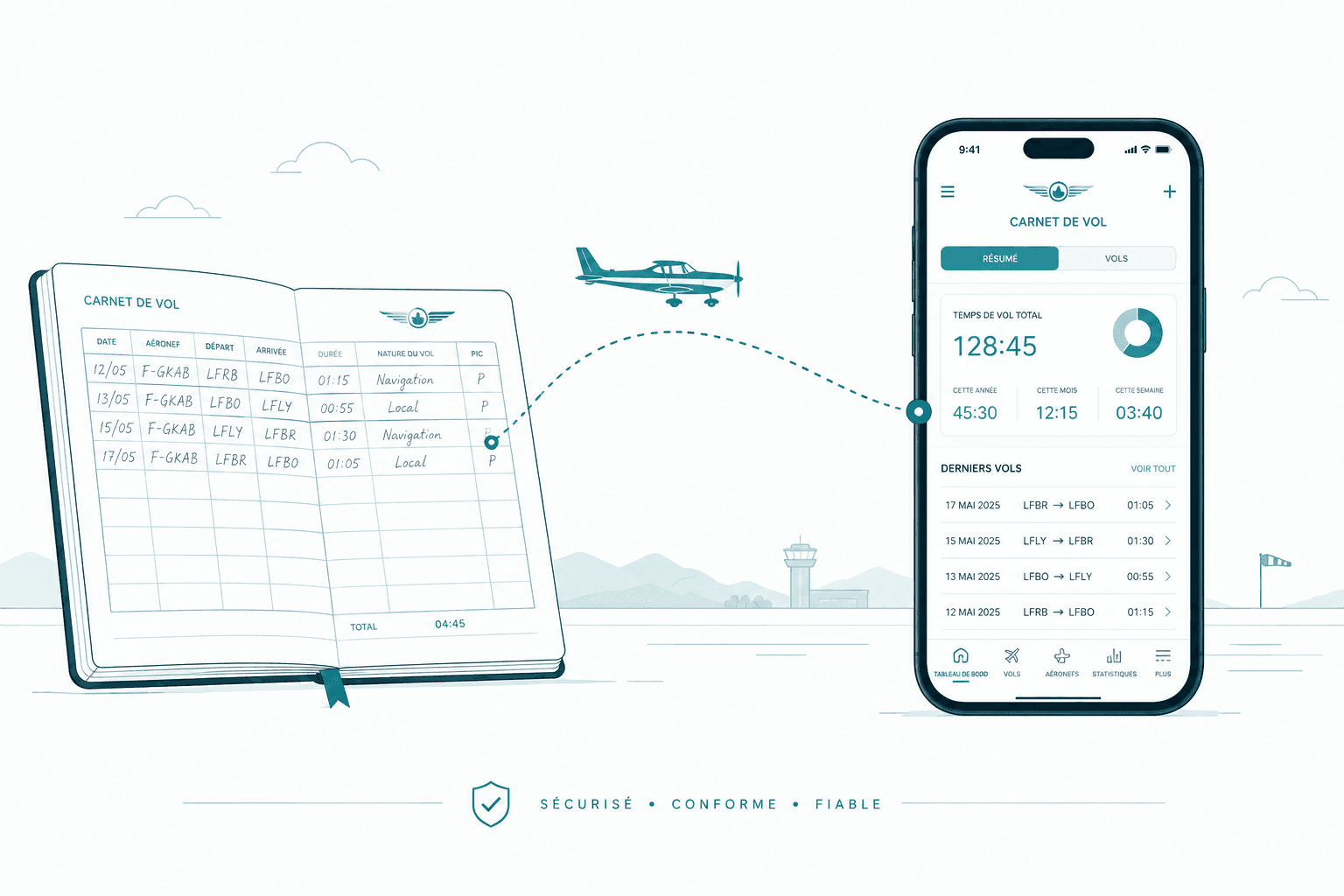
Ready to retire the paper logbook?
AerisLog logs your flights in 10 seconds, adds up your totals and keeps an eye on your deadlines. Free, on iOS and Android.